For teachers & schools
The LMS built for how music theory is actually taught.
Adaptive drills from real music, live theory games, and assessments you generate in seconds — for teachers who want fluency, not just a pass, and students who learn to think in music.
No sign-up — the demo drops you straight into a real instructor account.
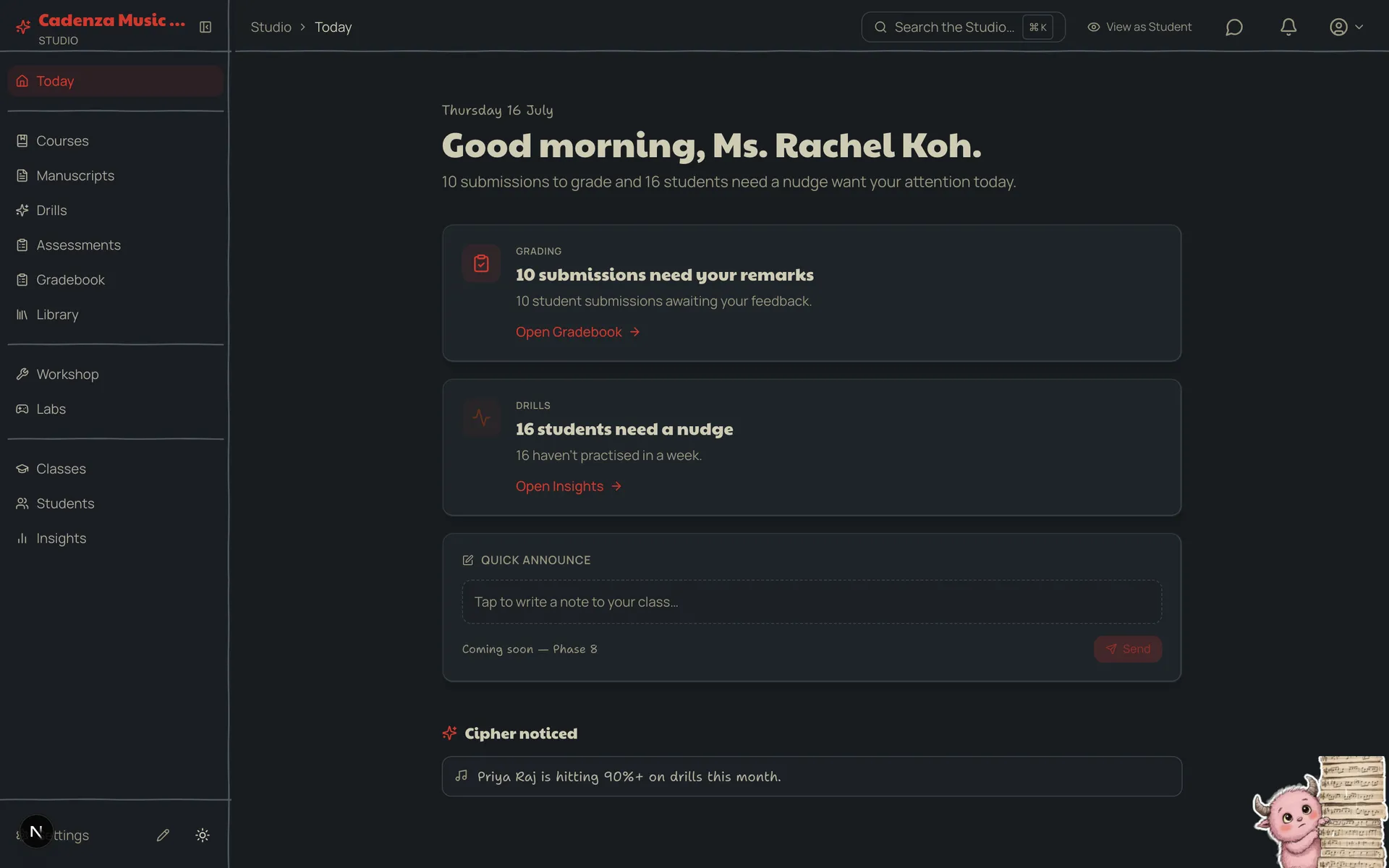

For teachers
Less admin. More teaching.
Everything you’d otherwise cobble together from worksheets, spreadsheets and slideware — in one place, built for music theory.
Assessments
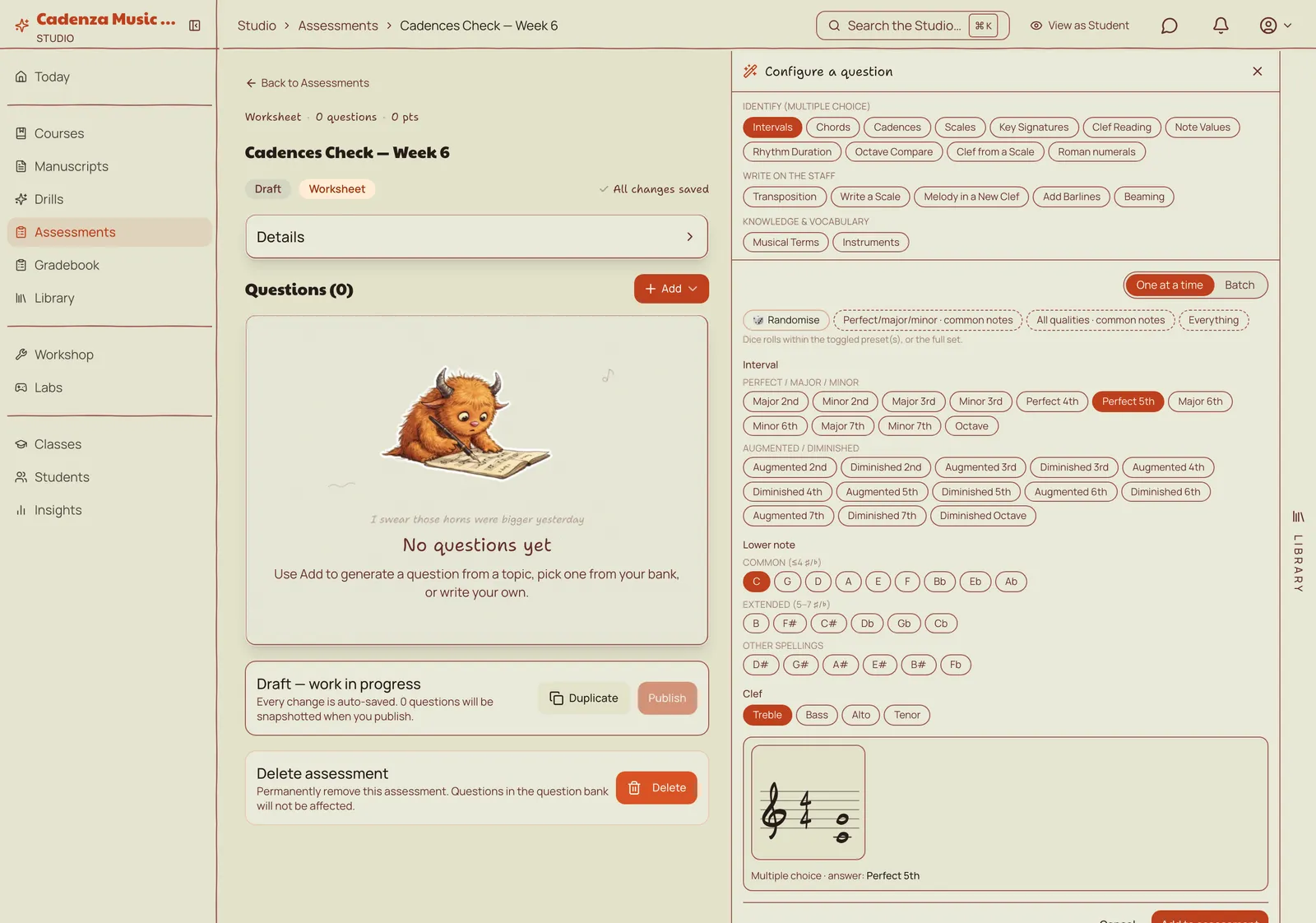
Assessments in seconds, not evenings
Pick a topic, set the parameters — key, clef, interval quality, voicing — and the engine drafts questions from a pool of thousands, rendered and answered live. Keep the ones you want, reroll the rest.
- Every Grade 5 topic: intervals, chords, cadences, scales, key signatures, Roman numerals, rhythm…
- Fine-grained control, or just hit Randomise
- You curate — it does the drudgework
Drills & assignments
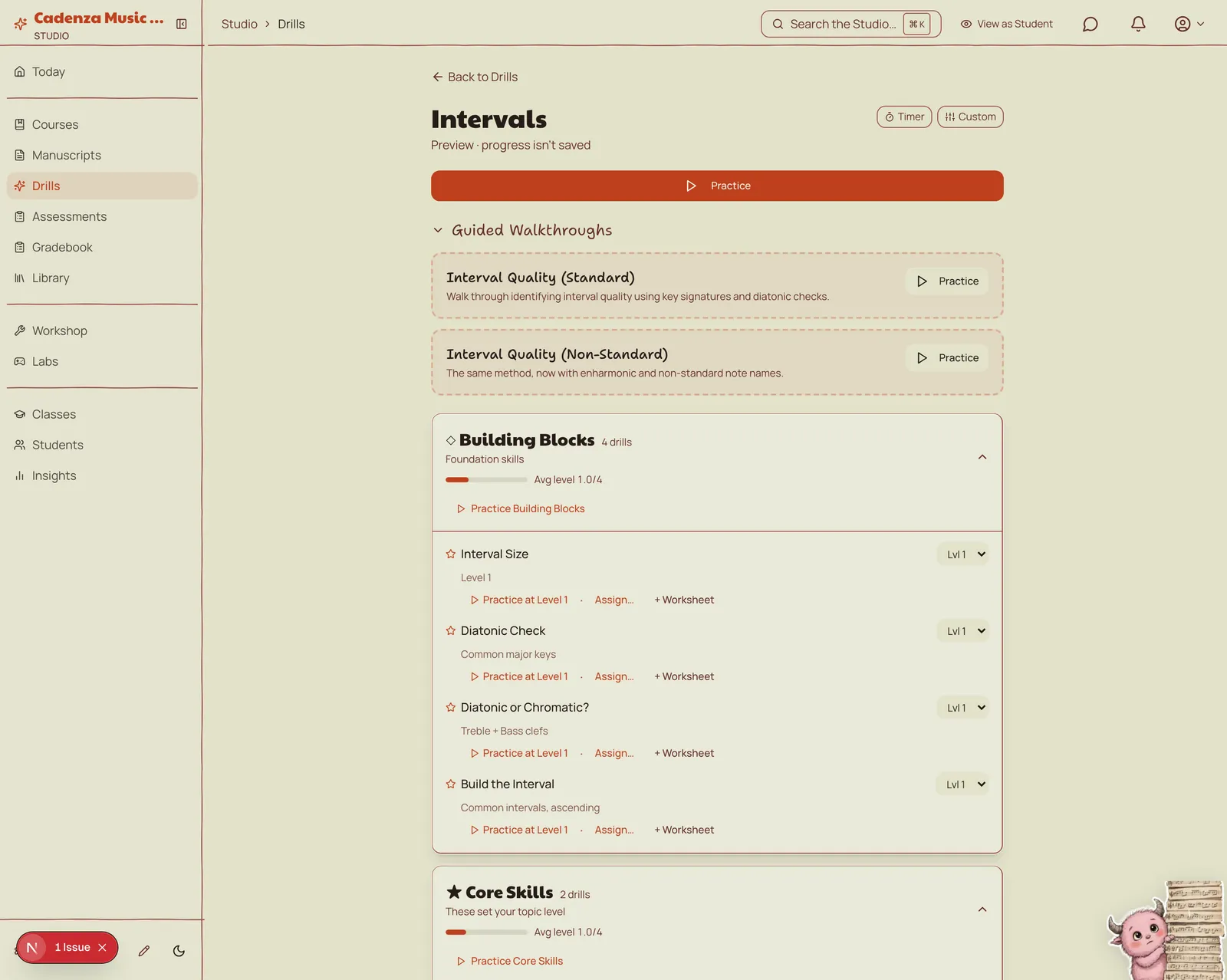
Drills that assign and grade themselves
Assign a topic in three clicks — Practice, Worksheet, or graded Mastery — to any cohort. Students get adaptive, spaced practice on real excerpts, and Mastery results land in your gradebook automatically.
- Scaffolded from foundation skills up to the target skill
- Guided walkthroughs teach the method, not just the answer
- Set the tier, the length, the class — done
Labs — live class games
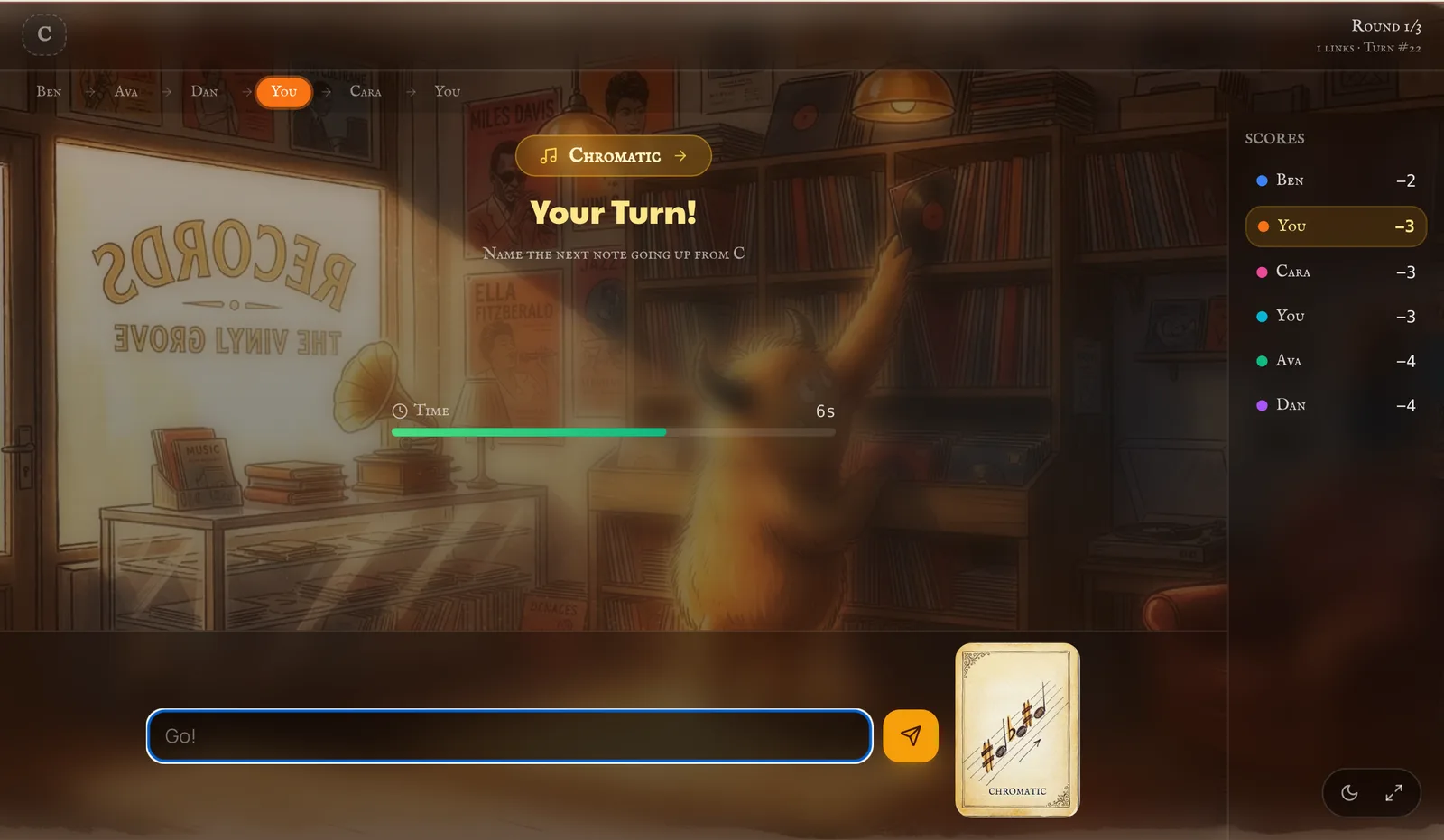
Live class games they'll ask to play
Musical Relay Chain, Saboteur and Rumminotes — games we designed from scratch for theory, where knowing the theory is how you win. Run them live over Zoom or in the room, and preview any session solo with bots before class.
- Original designs — not a familiar game with notes bolted on
- The theory is the mechanic, not a points wrapper
- Play action cards — Freeze, Reverse — to shake up the round
- Rehearse with bots before you teach
Labs — live whiteboard
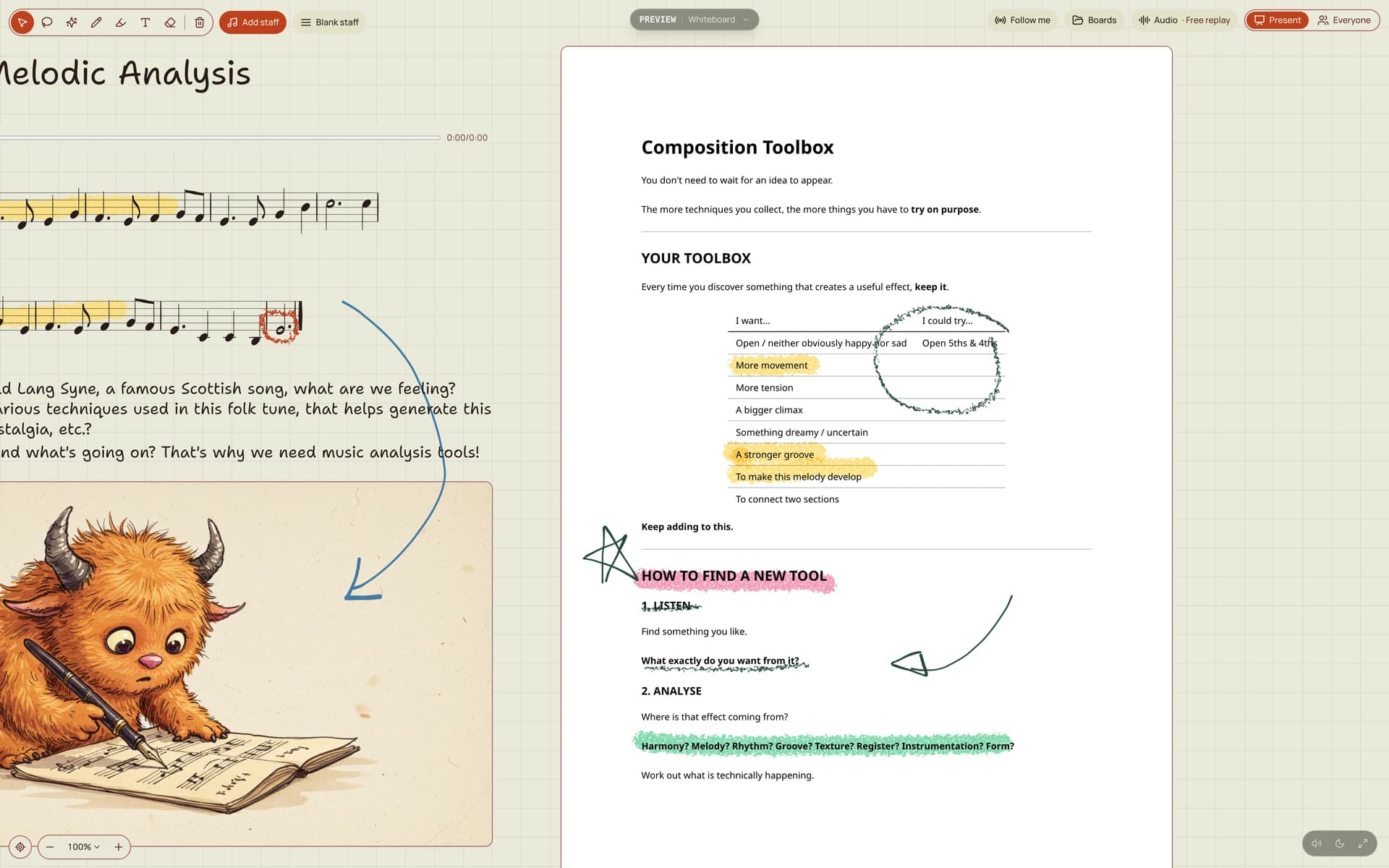
A whiteboard that speaks music
Sketch on a shared board and drop in real, playable staves — or pull up a worksheet or score and mark it up together. Then flip to Everyone and each student gets their own board to work out the answer, while the room fills in live in front of you.
- Write real, playable notation live — not a screenshot of a staff
- Import a worksheet or score and annotate it — pan, zoom, ink right over it
- Everyone mode: per-student mini-whiteboards — spotlight one answer to the class
- Aural work in full fidelity — every device plays the original recording in sync, not Zoom’s compressed call audio
- Runs over Zoom or in the room
Authoring
Build the whole lesson in one place
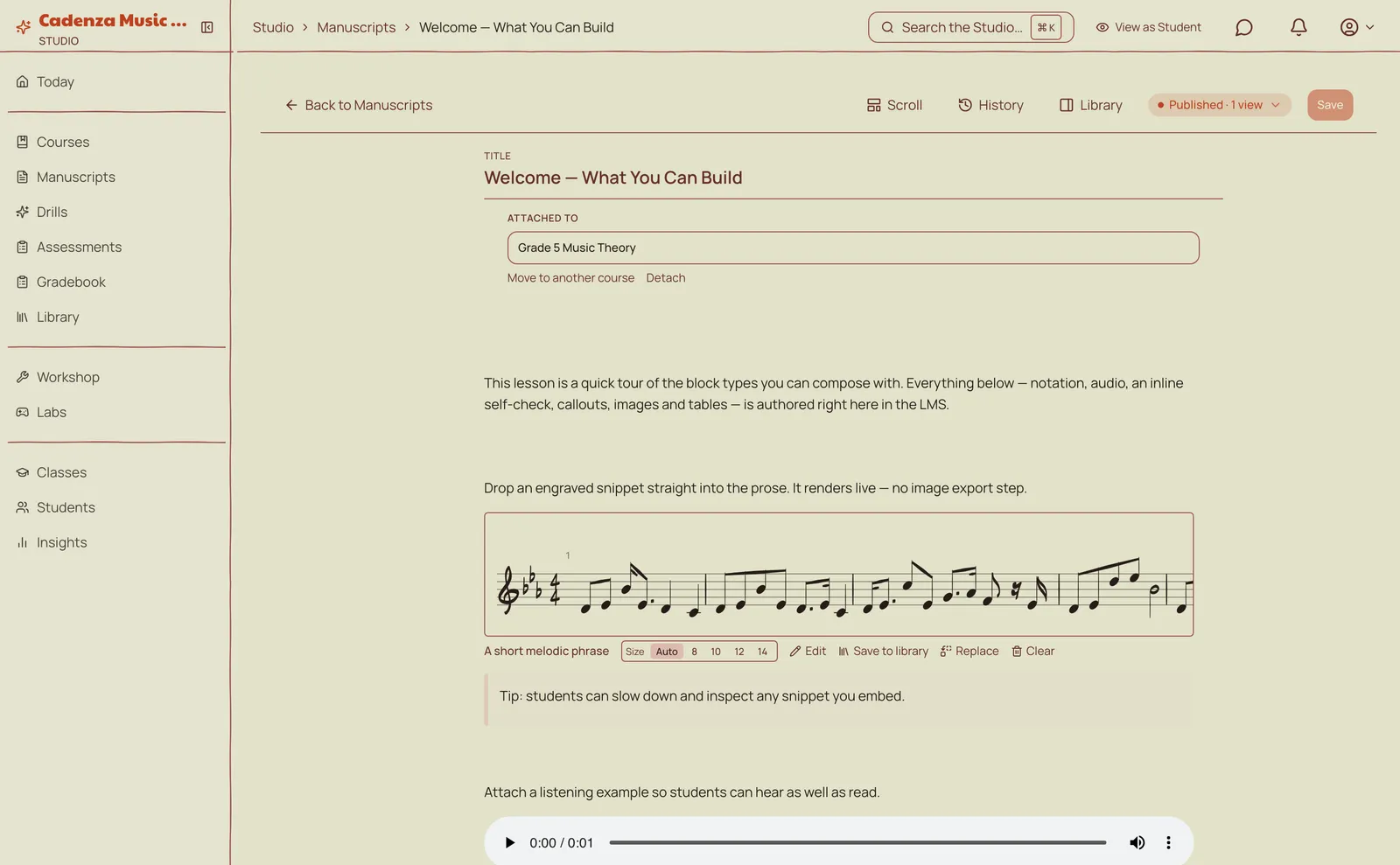
Compose a lesson with engraved notation, audio and interactive questions dropped straight into the prose — then hand it to students as a page, a document, or slides.
- Embed live-rendered notation and audio inline — no image export
- Inline self-check questions students answer to revise, right in the page
- Present as a scrolling page, an A4 document, or 16:9 slides
- Notate in the browser — no separate notation app, no screenshotting, no round-trips
- Author deliberate mistakes for students to spot and correct
For students
Learn to think in music.
Practice built to make the basics automatic — so working memory is free for the musical thinking on top.
Recall, not guesswork
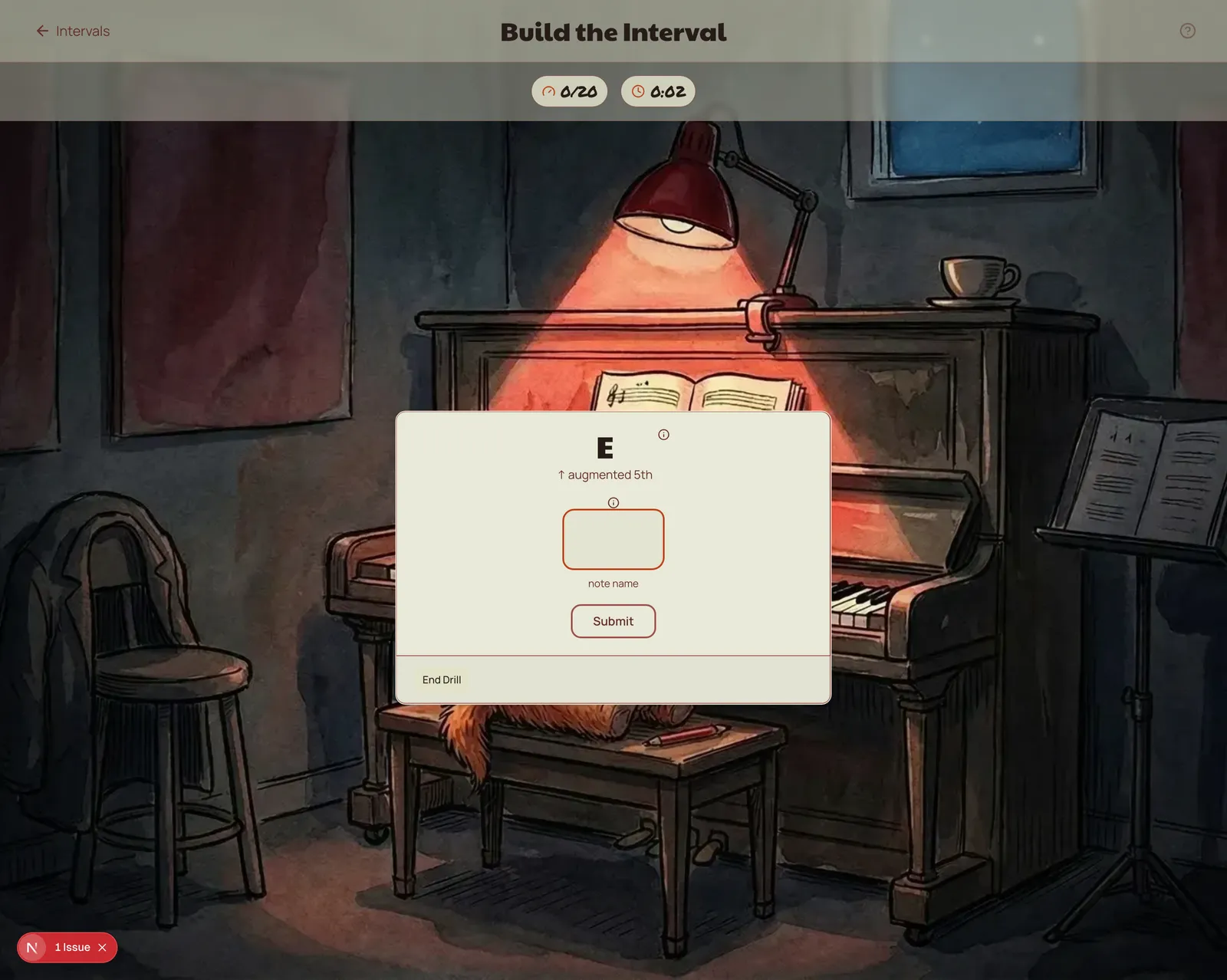
The prompt is “F ↑ minor 6th” — nothing to read, just the skill. You type the answer; you don’t pick from four options. Producing it is what makes it stick.
Every skill unlocks the next
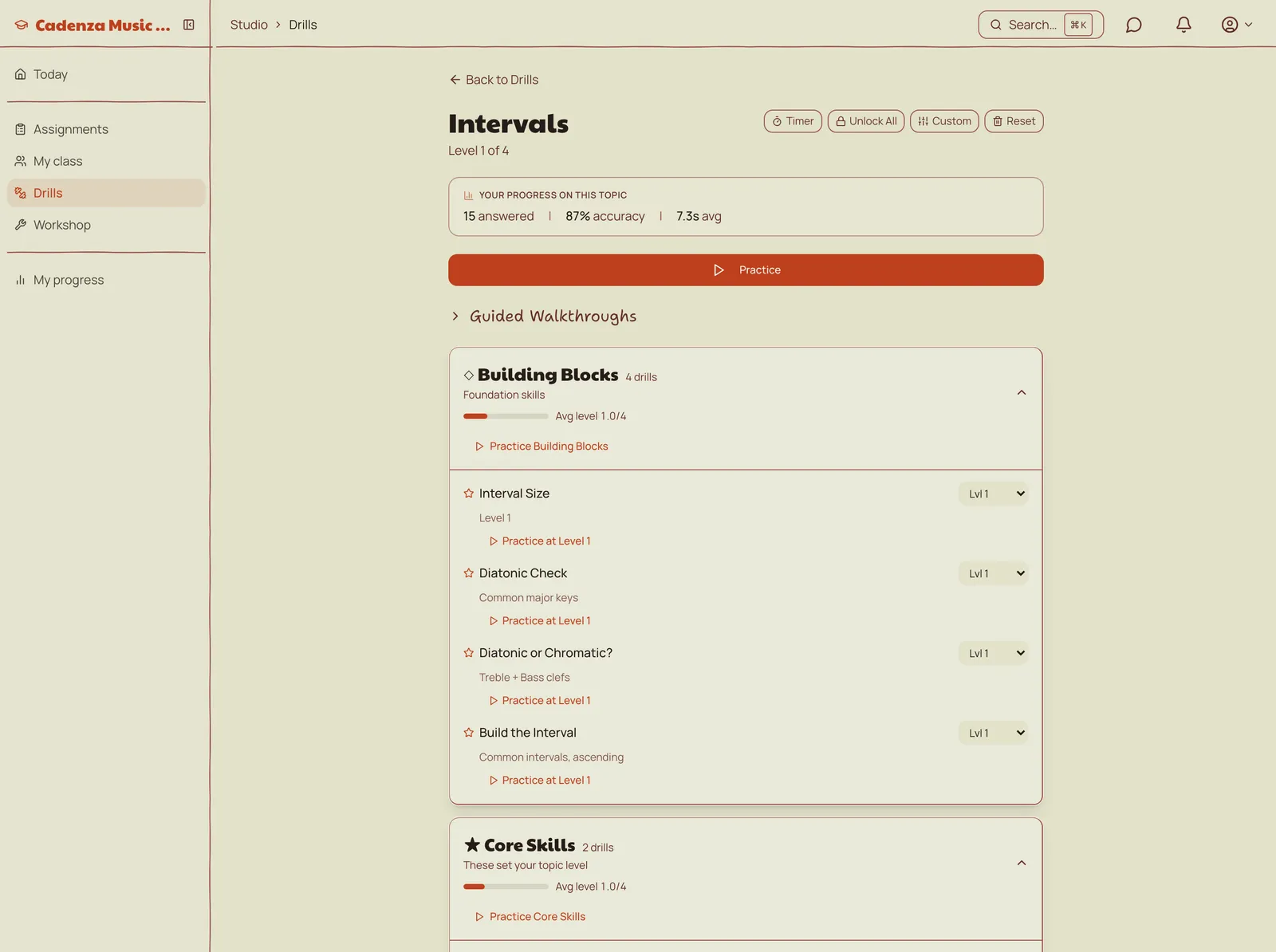
Foundations chain into the target skill — and a guided walkthrough shows exactly how they combine — then you drill the whole thing until it’s second nature.
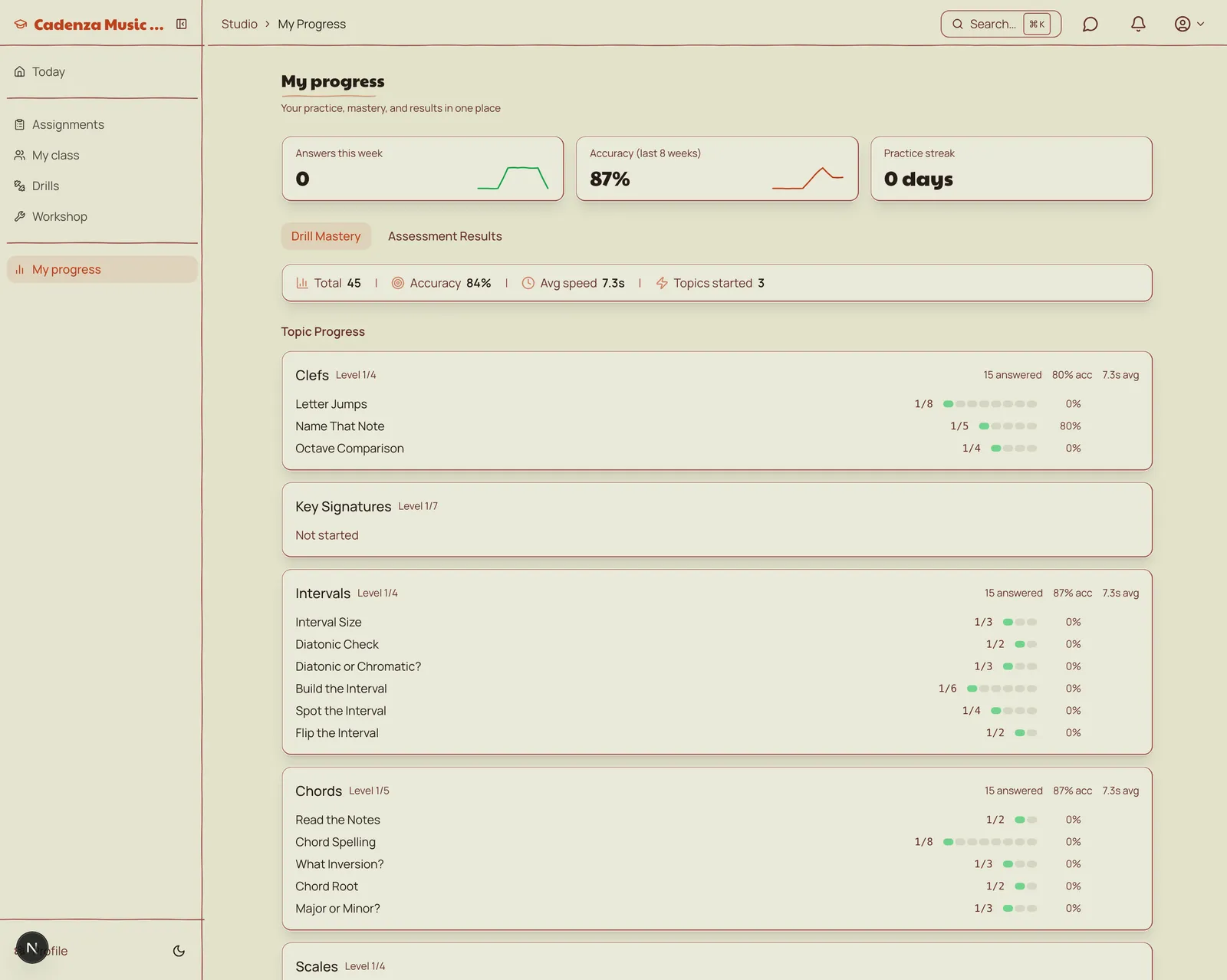
Fast enough to be automatic
You advance only when you’re accurate and quick. Mastery and streaks track the gap between “I can work it out” and “I just know it.”
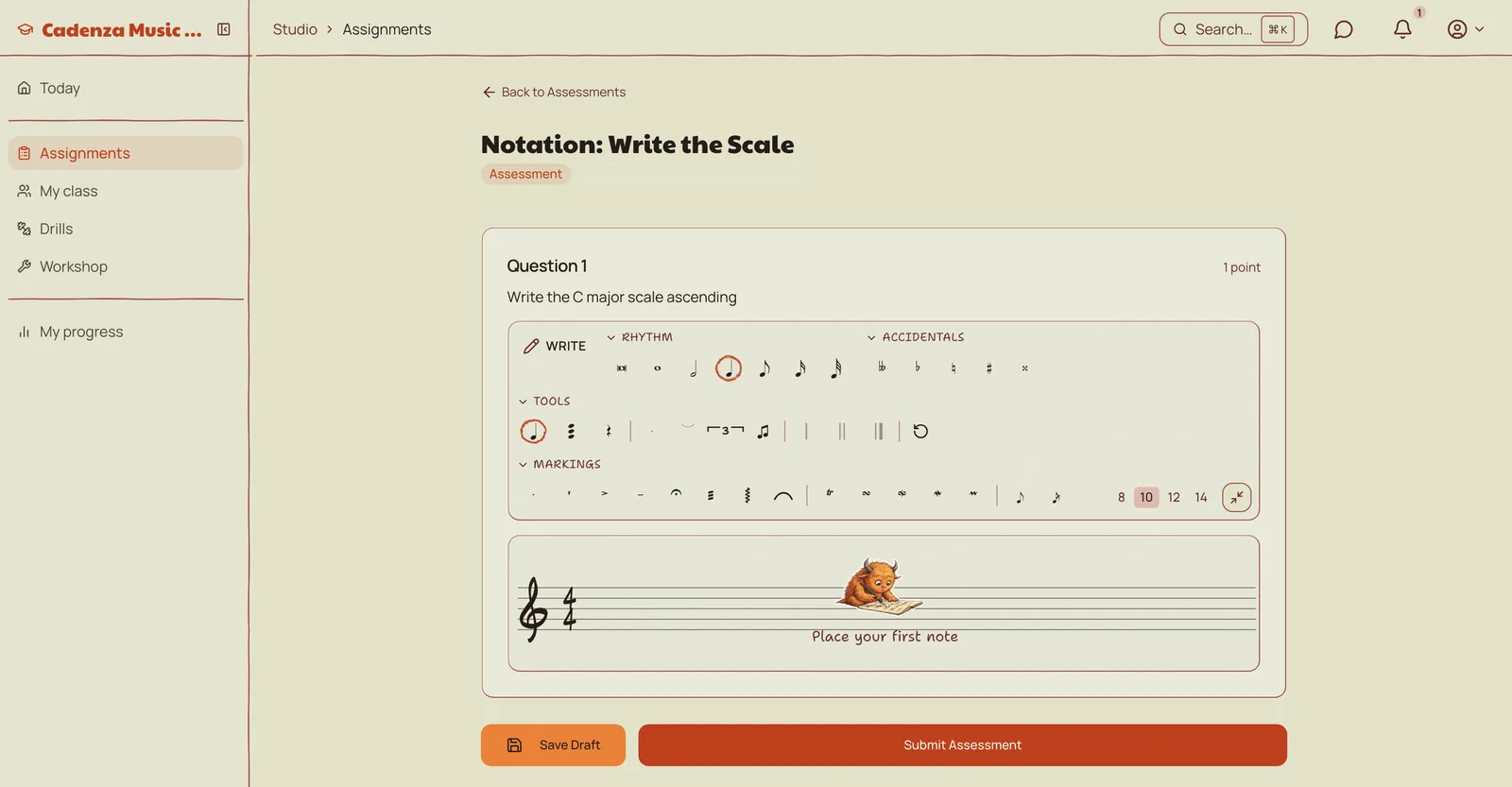
Sketchpad — an open canvas
Answer like it’s manuscript paper.
Students build the answer instead of picking from four — on a canvas that doesn’t pre-correct, so they can make (and learn from) the real mistakes, not just the obvious ones. And it still auto-grades; you can always adjust a mark.
Why learning from mistakes works — Kapur, 2008Workshop
Interactive tools for the concepts that trip students up.
Hands-on tools for the Grade 5 ideas that are hardest to hold in your head — built to be poked at, not just read about.
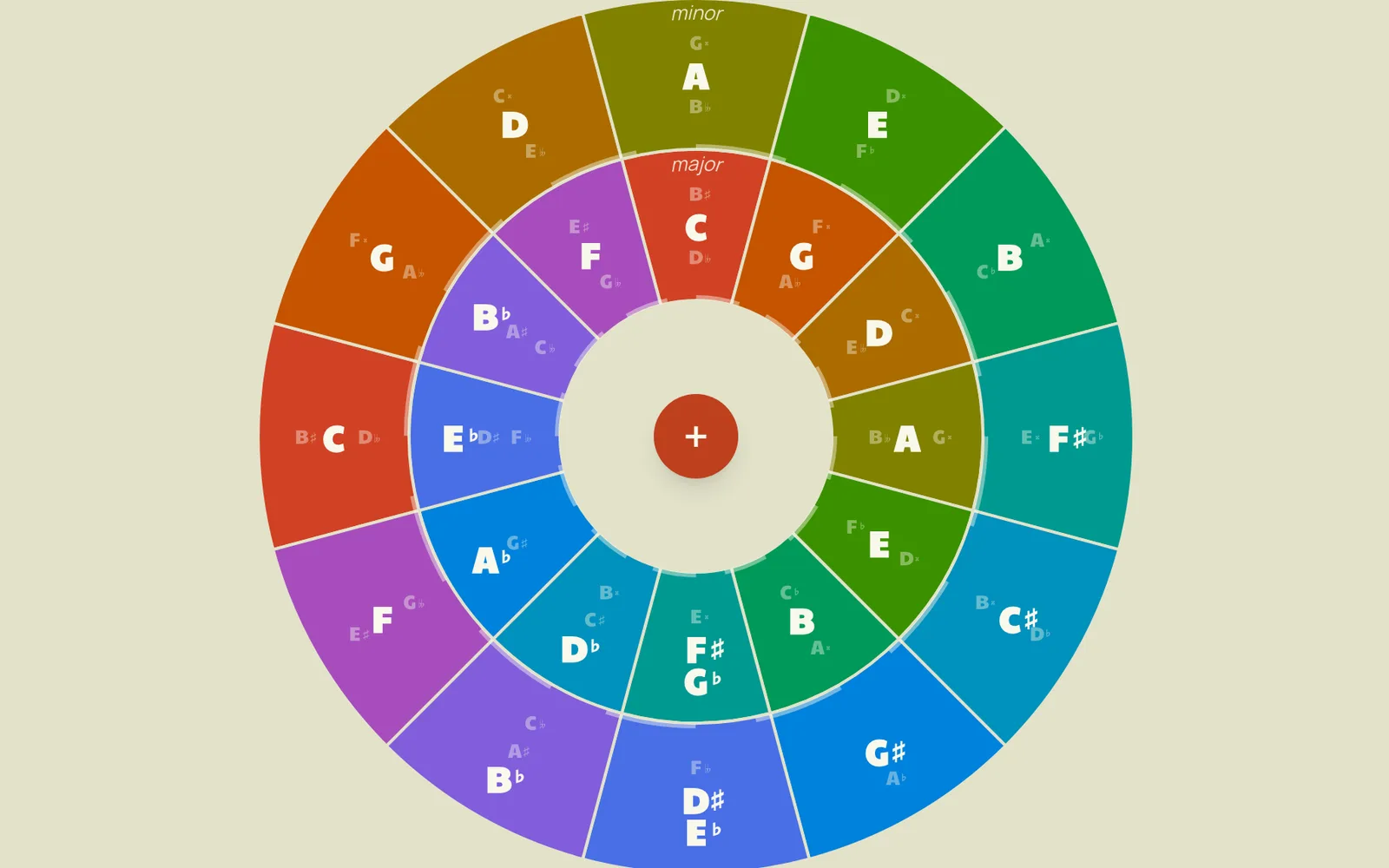
Circle of Fifths
Build and rotate the rings, or start blank and fill in your own spellings — then check whether your wheel is musically consistent.
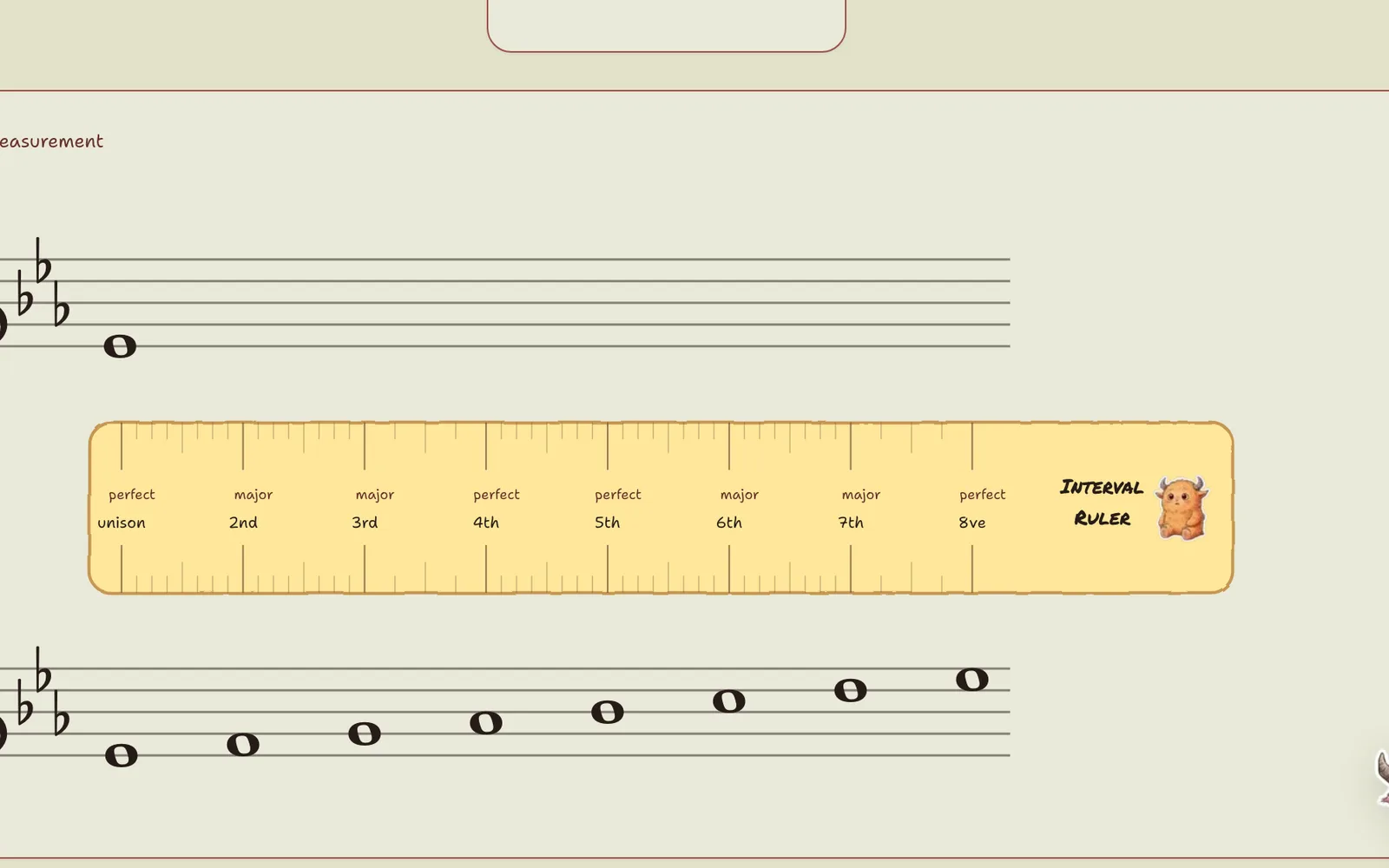
Interval Ruler
Measure intervals against a major-scale ruler — place notes, compare them to the scale tones, and see why an interval is what it is.
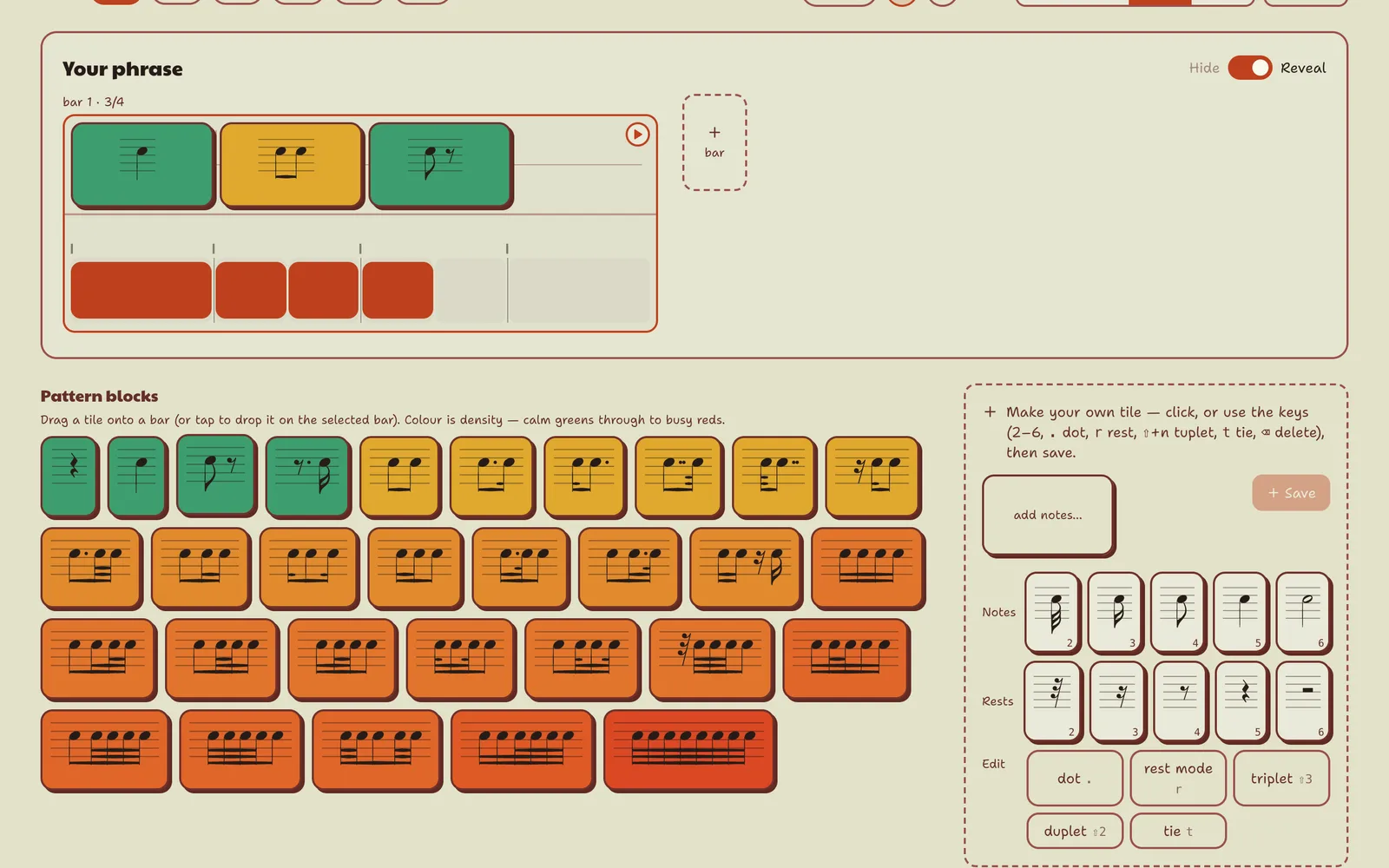
Rhythm Blocks
Build a rhythm from beat-patterns and hear it back, match written notation on the grid, or work one out by ear — three ways in.
The method
The gate is the diagnosis.
Most students aren’t blank slates or experts — they’re patchy. So instead of guessing what each one is missing, Ilvrant is built to find it and build it, in the order fluency actually forms.
Understand
Pattern first, then the why.
Students meet the shape of a concept before any rule, so the facts have a framework to land in — not just a list to memorise. Our workshop tools make the patterns hands-on: turn the wheel, place the notes, build the shape yourself rather than just read about it.
Automatize
Drill the base layers until they’re free.
You can’t manipulate intervals while you’re still counting note-skips. Fast, bite-sized drills push the foundations to automatic — and the mastery gate self-diagnoses: layers a student already owns clear in two minutes, missing ones get built. No placement test.
Apply
Games where the theory is how you win.
In our own multiplayer games, playing better means finding more routes into the same idea — C♯, D♭ and B𝄪 all being the note above C. Varied routes build flexible knowledge, and flexible knowledge is what transfers to real music.
Designed ND-first. That’s why it works for everyone.
Built by a neurodivergent brain, around how that brain actually gets fluent — explicit patterns instead of conventions absorbed by osmosis, foundations automated so working memory has room to think, short loops, fast feedback, nothing left implicit. Curb cuts were built for wheelchairs, and everyone with a suitcase uses them: design for the learners the standard approach fails, and the whole class runs better.
The story behind IlvrantTheory becomes something you think in — not something you look up.